About us
- Overview:
- In a world increasingly attentive to the delicate weave of cultures, ecologies and technologies, Multi‑Heritage stands as a distinctly cosmopolitan salon of learning—an Erasmus Mundus Joint Master’s that treats the globe itself as a campus, and heritage as an endeavour both scientific and humane. Over two years and 120 ECTS, students will progress through a deliberately choreographed journey—Romania to Italy to Portugal—culminating in fieldwork and thesis work across Czechia, Türkiye, Bulgaria or Slovakia, with co‑supervision spanning the full consortium. The experience is not a patchwork of exchanges but a single, integrated education: jointly designed, jointly delivered, jointly examined, and sealed by a Joint Master’s Degree accompanied by a Joint Diploma Supplement—the latter modelled explicitly on the Europass scheme developed by the European Commission, Council of Europe and UNESCO/CEPES.
- What marks Multi‑Heritage as rather singular is the breadth of its intellectual palette. Here, conservation chemistry converses with critical heritage theory; geoarchaeology meets virtual reconstruction; governance and ethics sit comfortably beside laboratory diagnostics and climate‑risk modelling. Students are trained to read a fresco and a dataset with equal subtlety, to speak in the idioms of policy and practice, and to write with academic rigour and professional deontology. This is interdisciplinarity not as slogan but as daily method, woven through modules in materials characterisation, documentation and digital curation, restoration planning, rights‑based participation, and open science practices. One emerges not merely with techniques, but with judgement—capable of evidence‑based intervention that preserves authenticity while embracing innovation.
- Why Choose Us?:
- The programme’s cultural complexion is as variegated as its curriculum. Each cohort moves through multiple national settings, acquiring the manners and methods of different academic traditions and professional milieus. Mobility is compulsory and credit‑bearing; recognition is automatic and joint; and the consortium’s governance—Board and Committees for Admissions, Examinations, Quality Enhancement, and Curriculum—assures an even standard of excellence from Târgoviște to Camerino, Tomar and beyond. This is multicultural formation in the classical sense: learning by inhabiting places and working with people, not merely reading about them. Associated Partners—museums, archives, laboratories, NGOs, public authorities and industry—open doors for fieldwork, internships and practice‑based projects, giving our students entrée to the living world of heritage stewardship.
- For prospective students with ambition equal to their curiosity, consider this your invitation. You will live and work in several countries, learn from teaching teams drawn from seven public universities, and write a thesis—research‑oriented, practice‑based, applied with a host, or even in the form of a peer‑reviewed article—co‑supervised across institutions. Careers follow in conservation and restoration, heritage science, collections care, documentation and digitisation, site and project management, cultural governance, consultancy—and for many, the doctoral path. If your aspirations are international, interdisciplinary and impact‑minded, Multi‑Heritage offers the polish and the platform to match them—an education of breadth, depth and consequence, in the company of peers and professors who take culture seriously and the future personally.
- Applications are handled centrally and selection is joint; all mobility and achievements are recorded in your Joint Diploma Supplement. When you are ready to bring science, ethics and community into concert for the sake of heritage—tangible, intangible, digital and natural—we shall be delighted to make your acquaintance.
- Consortium:
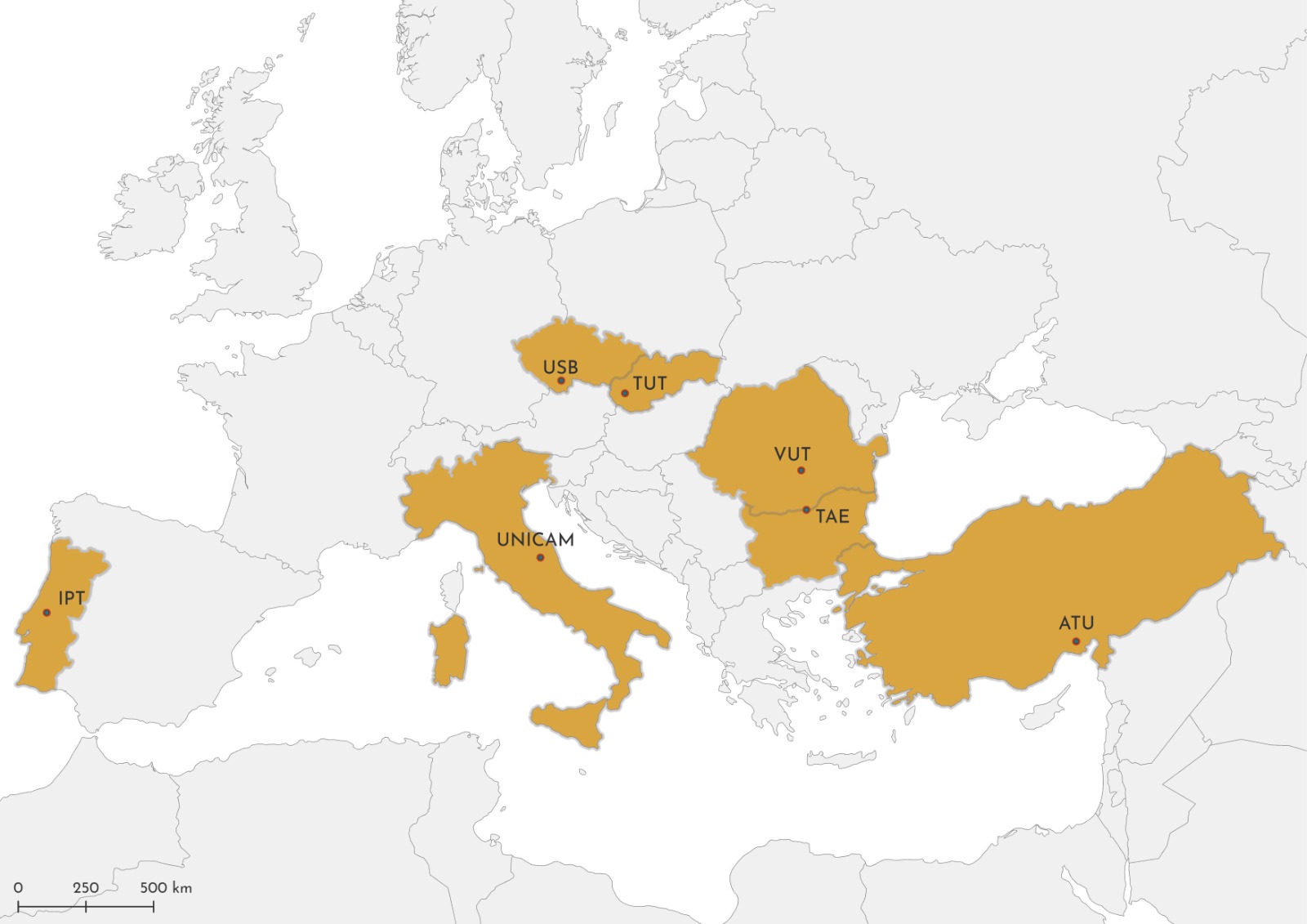
- The Multi‑Heritage Programme is delivered by seven full member universities, each contributing teaching, research, fieldwork, supervision, and student services:
- Valahia University of Târgoviște (VUT), Romania – Coordinating Institution
- University of Camerino (UNICAM), Italy
- Polytechnic Institute of Tomar (IPT), Portugal
- University of South Bohemia (USB), Czechia
- Trnava University (TUT), Slovakia
- Adana Alparslan Türkeş Science & Technology University (ATU), Türkiye
- D. A. Tsenov Academy of Economics (TAE), Bulgaria
- All students follow a structured physical mobility pathway:
- Semester 1: Romania – Valahia University of Târgoviște
- Semester 2: Italy – University of Camerino
- Semester 3: Portugal – Polytechnic Institute of Tomar
- Semester 4: Fieldwork in Czechia, Türkiye, Bulgaria, or Slovakia + thesis mobility across all partners
- The Multi‑Heritage Programme is delivered by seven full member universities, each contributing teaching, research, fieldwork, supervision, and student services:
- Accreditations:
- Our openness is not accidental; it is an ethic. Our Joint Degree Policy aligns the programme with the European Qualifications Framework (EQF Level 7) and the European Higher Education Area, and our Diploma Supplement follows the Europass template expressly to promote transparency, mobility and fair recognition—core European and UNESCO priorities for higher education and culture. Quality assurance is anchored in the European Standards and Guidelines and the European Approach to Quality Assurance of Joint Programmes; accreditation is coordinated through Italy’s ANVUR with all partners upholding their national obligations. In short, the programme answers Europe’s call for integrated, student‑centred, cross‑border education while responding to UNESCO’s transparency and recognition agenda—so that what students achieve is intelligible and valued wherever they go.
- Graduates receive a Joint Master’s Degree in Interdisciplinary Heritage Studies, signed by all degree‑awarding universities. A Joint Diploma Supplement documents the full mobility path and learning outcomes.